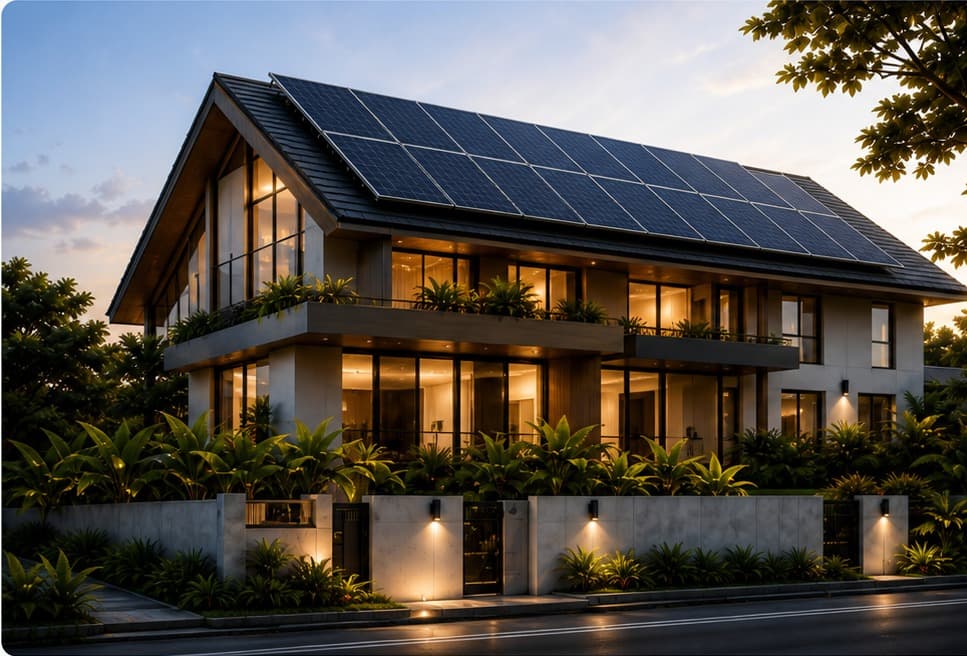
Is my roof suitable for solar?
Most landed roofs are. What really matters is enough unshaded area, a roof in good condition, and spare electrical capacity. Here is how to check yours before anyone climbs a ladder.
The five checks
What makes a roof suitable.
A good solar roof comes down to five things. Most landed homes tick all five without trying.
Enough usable area
Roughly 5 to 6 m² per kWp. A typical landed roof easily holds 8 to 20 kWp of usable space.
A sound, watertight roof
Panels last 25 years, so the roof underneath should be in good condition and not due for replacement soon.
Good sun, little shade
Few tall trees or neighbouring blocks casting shade across the middle of the day.
A workable orientation
Singapore is near the equator, so most pitches and directions work. Flat roofs are tilted to face the sun.
Spare electrical capacity
Single-phase supports up to ~13 kWp; three-phase allows much larger systems.
By house type
Roughly what fits where.
A rule of thumb for usable roof by landed type. Yours will differ, but it sets expectations.
Terrace
6 – 10 kWp
Smaller roof, usually single-phase.
Semi-detached
10 – 16 kWp
Often near the single-phase ceiling.
Bungalow / detached
16 – 30+ kWp
Large roof, frequently three-phase.
The honest catch
When a roof falls short.
Some roofs are not worth it, and we will say so. The usual reasons:
- The usable roof is tiny, or broken up by skylights, vents, and pitches.
- Tall trees or neighbouring buildings shade the roof for much of the day.
- The roof is old and likely to need replacing within a few years.
Know for sure
A checklist only gets you so far.
The only way to know your roof for certain is to measure it. Book a survey and we check the area, shading, condition, and your supply in person, with no obligation to go ahead.
Common questions
Roof questions, answered.
Not when it's mounted properly. Leaks come from rushed or careless work, not from solar itself. On tiled roofs we use tile hooks that lift panels above the tiles; on metal roofs, non-penetrative clamps. A site survey checks your roof's actual condition first, so you know before committing.
Partial shade is workable. Panels can be laid out to avoid the worst areas, and optimisers or microinverters limit the impact. A survey maps your shading across the day.
Most landed roofs are. What matters is enough unshaded, usable area, a roof in sound condition, and spare electrical capacity. A site survey confirms it precisely.
Roughly 5 to 6 square metres of usable, unshaded roof area per kWp. A useful system for a landed home starts at about 5 to 8 kWp, so you need at least 25 to 50 square metres of workable roof. Broken pitches, skylights, and shaded sections reduce usable area, which the site survey maps precisely.
Less than in countries further from the equator. Singapore sits close to the equator, so the sun travels high and mostly overhead. North, south, east, and west-facing roofs all capture reasonable irradiance. South-facing is marginally better for most of the year, but a larger east or west-facing roof often outperforms a smaller south-facing one.
Check your distribution board in the meter room or utility cupboard. Single-phase supply has one live wire; three-phase has three. Your Sunnify site survey confirms this, as it directly affects the maximum system size your home can support.
Active leaks, rotting timber structures, asbestos cement sheets, and roofs within a few years of needing full replacement. Installing solar on a roof that then needs replacing means dismounting and remounting the panels at extra cost. A survey checks the condition before you commit.
Go deeper
The detail, if you want it.
Keep reading
The rest of the decision.
Is it worth it?
Are solar panels worth it?
The honest verdict, the real payback, and when it is not worth it.
Read guideWhat it costs
How much does solar cost?
Real 2026 prices, per kWp and total, and where every dollar goes.
Read guideWho to trust
How to choose an installer
Green flags, red flags, and the questions that protect you.
Read guide