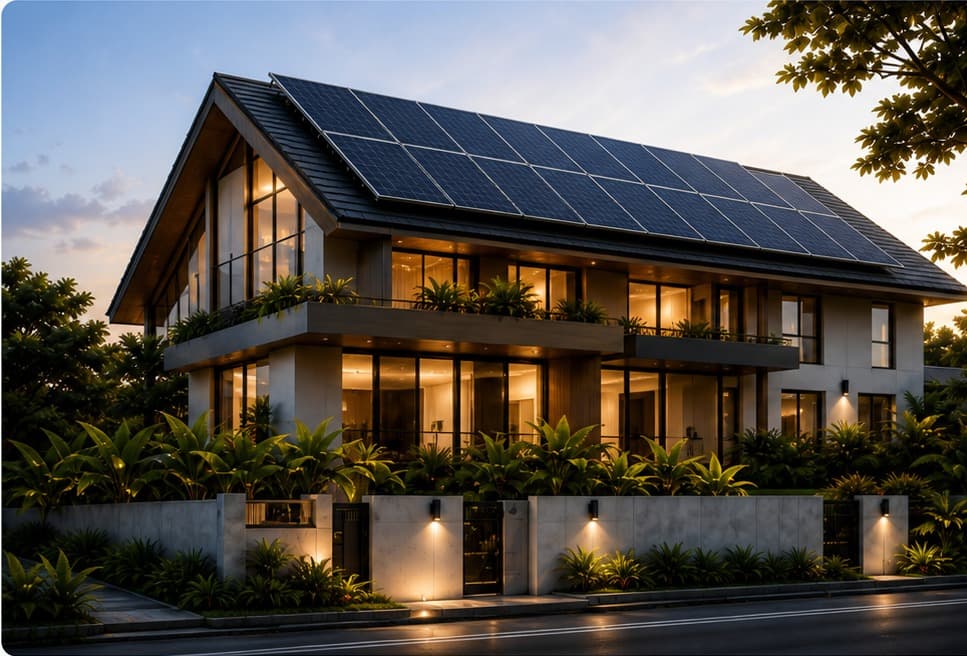
Are solar panels worth it in Singapore?
Short answer: for most landed homes, yes. The maths is better than it used to be. But it is not worth it for everyone. This page gives you the real numbers and the honest catches, so by the end you will know which side you are on.
The honest answer
Worth it, when three things line up.
Solar is a five-figure decision, and most of the internet is written by people who only profit if you say yes. So here is the version with no pitch: solar pays off for your home when all three of these are true.
Enough usable roof
Most landed homes have plenty. A typical terrace or semi-detached roof comfortably fits a 6 to 12 kWp system.
A high enough bill
Around S$150 a month or more. The bigger your bill, the more solar has to work with, and the faster it pays back.
Not heavily shaded
A roof that catches good midday sun, without tall trees or neighbouring buildings throwing it into shade.
Tick all three, and the numbers in the next section are probably yours to claim.
The real numbers
What it looks like in dollars.
Most landed homes install between 12 and 20 kWp, often bigger than people expect, because at today’s export rate it pays to fill the roof rather than just cover your own usage. Here is roughly how a mid-sized 15 kWp system stacks up.
~15 kWp
System size
~S$18k
Installed cost
~S$4k
Saved a year
~5 yrs
To pay back
Your 25-year picture
Paying it back
Years 0–5
~20 years of pure savings
Years 5–25
That last part is what the payback number alone hides. Once the system has paid for itself around year five, it keeps generating for two more decades, quietly turning your roof into one of the steadier returns you can make on your home.
How big can you go?
Your system size is capped by two things: how much usable roof you have, and your home’s electrical supply.
Single-phase
~13 kWp max
What most landed homes run on, and the practical ceiling for it.
Three-phase
20–50+ kWp
Far more headroom for bigger roofs and higher bills.
Where the money comes from
Two ways solar pays you.
Understanding these two is the whole game. Both matter in Singapore, and in 2026 the second one is finally worth real money again.
Power you use
Every unit your panels make and you use straight away is a unit you do not buy from the grid at about S$0.30/kWh. This is the biggest saving.
Power you export
Whatever you do not use flows back to the grid, and SP currently pays around S$0.22/kWh for it. Real money, even when no one is home.
How solar export works in SingaporeMost landed homes are quiet through the sunniest hours, so a good share gets exported. That is fine. At S$0.22, export still pulls real weight in your payback.
The honest catch
When it is not worth it.
A salesperson skips this part. We would rather say it now than put you in a system you regret. Solar may not pay off if:
- Your monthly bill is under about S$150, so the savings stay small.
- Your usable roof is tiny, or in shade for much of the day.
- You are about to move, or the roof needs replacing first.
For everyone else, a sound, sunny roof with a real bill makes solar one of the safer long-term returns you can make on your home.
So, is it worth it for you?
Only your roof can answer that.
Every home sits a little differently to the sun. The honest answer is your own numbers, not a national average. See your estimate in two minutes, or book a survey and we will measure your actual roof before anyone talks about money.
Common questions
Still wondering?
Yes. Power you do not use is exported to the grid, and SP currently pays around S$0.22 per kWh for it. You earn from export even when nobody is home.
If your bill is under about S$150 a month, or your usable roof is small, the savings may be too modest to justify the cost. We will tell you honestly if that is your situation.
About 5 to 6 years for most suitable landed homes at current installed prices and SP 2025 tariffs. After that, the system runs largely free for the rest of its 20 to 25 year life.
A typical 15 kWp system on a suitable landed home saves roughly S$3,000 to S$4,500 per year at current SP tariff rates. A smaller 8 kWp system on a terrace might save S$1,500 to S$2,500. The figure depends on your bill, roof area, and how much power you use during daylight hours. The Sunnify calculator gives you a specific number for your address.
Singapore's average of 4.33 peak sun hours per day already accounts for cloud cover and seasonal variation. The country sits close to the equator and receives consistent irradiance year-round. Rainy days reduce daily output, but they do not significantly change the annual total used in payback calculations.
No. Singapore's SolarNova programme targets HDB blocks and government buildings, not private landed homes. There is no grant, subsidy, or rebate available for landed homeowners as of 2026. The payback calculation stands on savings from self-consumed power and SP export payments alone.
It can, but Singapore buyers do not yet price solar into offers as systematically as buyers in Australia or the US. The more tangible benefit is the lower running cost you can show on paper. A buyer who understands the electricity bill savings may factor it in. Either way, the panels outlast most mortgages.
Go deeper
The detail, if you want it.
Keep reading
The rest of the decision.
What it costs
How much does solar cost?
Real 2026 prices, per kWp and total, and where every dollar goes.
Read guideWill it fit?
Is my roof suitable?
Size, shading, orientation, and supply, checked the honest way.
Read guideWho to trust
How to choose an installer
Green flags, red flags, and the questions that protect you.
Read guide