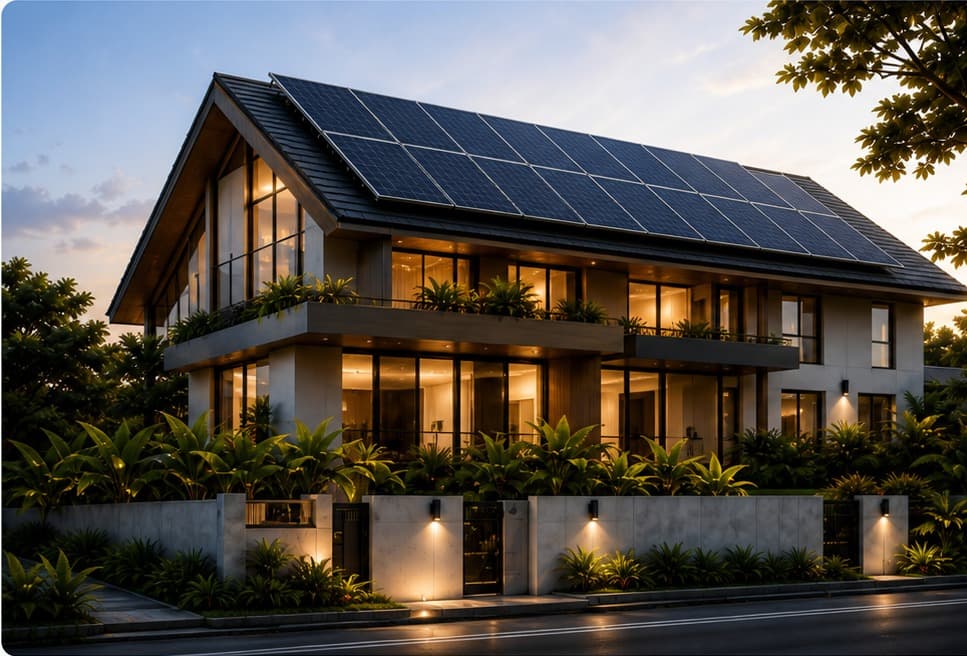
Solar on a tiled vs metal roof in Singapore.
Both work well. Metal is the simplest and cheapest to fit; tiled takes more care and a better installer. Here is the honest comparison.
Side by side
Metal vs tiled, honestly.
For the full installed price breakdown covering both roof types, see how much solar panels cost in Singapore.
The part that matters
On a tiled roof, the installer is everything.
Solar does not make a roof leak, rushed or unskilled mounting does. On tiles, that means proper tile hooks, careful flashing, and a crew that is not racing the clock. It is one more reason a suspiciously cheap quote is worth a second look. A survey checks your exact roof first.
Common questions
Roof types, answered.
Not if it is mounted properly. Leaks come from rushed or unskilled work, not from solar itself. This is exactly why the installer you choose matters on a tiled roof.
Usually a little. Metal roofs use non-penetrative clamps that are quick to fit and do not pierce the roof, so labour is lower and the leak risk is minimal.
Flat roofs work too. Panels sit on tilted, often ballasted frames angled to catch the sun, with no need to pierce the slab.
Tile hooks are slid under lifted tiles and secured to the roof rafters below. The tiles are then lowered back into place around the hook, and rails bolt to the protruding hook. This avoids piercing the tile face. Mounting points need sealing, and the crew must lift and replace tiles without cracking them.
No. Asbestos cement sheets require specialist removal before any work begins. Solar panels cannot be mounted on them, and disturbing asbestos material without proper handling is a safety and legal violation. The roof must be replaced with a compliant material before solar installation can proceed.
If your roof is in good condition, no. If it is near the end of its serviceable life, yes. Dismounting and remounting panels when the roof eventually needs replacing adds cost. A site survey checks the roof condition and gives you an honest view on whether to re-roof first.
Slightly. Steeper pitched roofs shed soiling faster in rain, reducing cleaning frequency. Flatter pitches accumulate dust and residue more quickly. The optimal tilt for Singapore is roughly 10 to 15 degrees, but fixed pitches of 20 to 30 degrees still perform well. RC flat roofs use tilted mounting frames to reach an effective angle.
Integrated solar tiles, sometimes called BIPV (Building-Integrated Photovoltaics) or branded as Tesla Solar Roof, replace the roof covering itself with solar-generating tiles. They exist commercially but are not widely available from Singapore installers as of 2026, and cost roughly three to four times more per watt than conventional panels mounted on an existing roof. For most landed homeowners here, standard panels on your existing metal or tiled roof deliver the same electricity output at a fraction of the price. If your roof needs full replacement anyway, BIPV is worth asking installers about. If it is in good condition, conventional panels are the practical choice.
Keep reading
The rest of the decision.
Is it worth it?
Are solar panels worth it?
The honest verdict, the real payback, and when it is not worth it.
Read guideWhat it costs
How much does solar cost?
Real 2026 prices, per kWp and total, and where every dollar goes.
Read guideWill it fit?
Is my roof suitable?
Size, shading, orientation, and supply, checked the honest way.
Read guideWho to trust
How to choose an installer
Green flags, red flags, and the questions that protect you.
Read guide