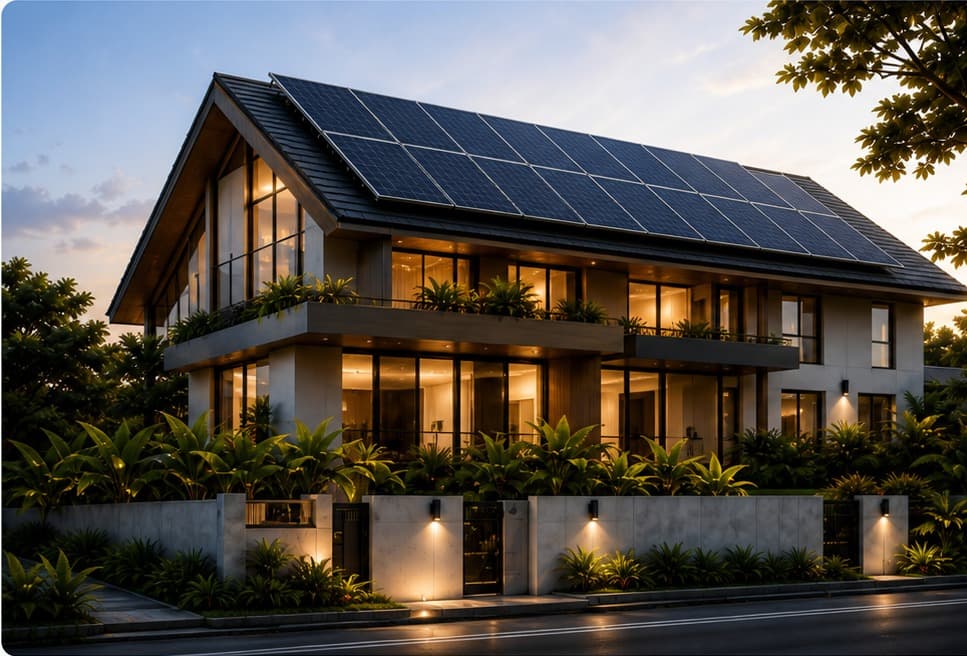
Terrace House Solar Singapore: System Sizes, Costs, and What to Expect
A Singapore terrace house with 50 to 80 sqm of usable roof can support 6 to 10kWp of solar. At 10kWp and S$13,000, annual savings reach S$3,103 with a 4.2-year payback. The process from site survey to first generation takes 4 to 8 weeks.
Why should this article concern you?
- 1
A standard Singapore terrace house can fit 14 to 22 panels (6 to 10kWp) depending on roof type, orientation, and usable area
- 2
A 10kWp terrace system at S$13,000 saves S$3,103 per year and pays back in 4.2 years at the Q3 2026 tariff
- 3
The installation process runs 4 to 8 weeks from survey to SP Group commissioning, faster for south-facing roofs with no structural complications

Terrace houses are the most common landed property type in Singapore and represent the largest solar installation opportunity in the residential sector. A standard 2-storey terrace with a typical 50 to 80 sqm roof area can accommodate 6 to 10kWp of solar, enough to offset 40 to 70% of the average household's annual electricity consumption and generate S$2,200 to S$3,100 in annual savings at the Q3 2026 tariff.
How Many Panels Fit on a Singapore Terrace Roof
The limiting factor on a terrace house is usable roof area. A standard intermediate terrace in Singapore has a gross roof area of approximately 100 to 120 sqm across both pitches. From this, deduct the roof overhang, ridge zone, any air conditioning condensing unit placement, and water tank areas. Typically, 50 to 70 sqm of usable panel area remains on one or both pitches combined.
A standard 400–455W panel occupies roughly 1.8 to 2.0 sqm including racking clearances. On 60 sqm of usable area: 20 to 22 panels, giving approximately 8 to 10kWp. On 50 sqm: 16 to 18 panels, giving 6 to 8kWp. Corner terraces and end terraces often have additional gable-end or side roof faces that increase available area.

Terrace House System Size and Savings: Three Scenarios
| System Size | Panels | Annual Generation | Annual Saving | System Cost | Payback |
|---|---|---|---|---|---|
| 6 kWp | 14–15 panels | 6,636 kWh/yr | S$1,862/yr | S$7,800 | 4.2 yrs |
| 8 kWp | 18–20 panels | 8,848 kWh/yr | S$2,483/yr | S$10,400 | 4.2 yrs |
| 10 kWp | 22–24 panels | 11,060 kWh/yr | S$3,103/yr | S$13,000 | 4.2 yrs |
The payback period is nearly identical across system sizes because cost per kWp is relatively flat. What changes is the absolute annual saving. A 5-person household using 550 to 650 kWh per month benefits from a 10kWp system that offsets roughly 65 to 75% of consumption in generation terms. A smaller 3-person household using 350 kWh per month is better served by a 6 to 8kWp system whose generation more closely matches their consumption profile, maximising self-consumption.
North vs South Orientation on a Terrace
At Singapore's latitude of 1.3°N, the sun arc passes almost directly overhead. Both north and south-facing roof pitches receive direct sun at different times of day and year. A south-facing roof performs approximately 5 to 10% better than north-facing in annual total generation, but the difference in dollar terms for a 10kWp system is roughly S$150 to S$310 per year, not the dramatic gap it would be in Europe.
Most installer site surveys will prioritise the pitch with fewer obstructions, better structural access, and the most available area. This is the right approach. Maximising panel count on the better structural pitch outweighs the orientation benefit in most Singapore terrace configurations.

The question is not which pitch of your terrace faces south. It is how much area is available, what the roof structure can support, and whether any installers are cutting a corner on LEW sign-off to reach the lowest quote number.
For a site-specific estimate using your property address and household consumption, run the Sunnify estimate tool. It uses satellite roof data and current SP Group tariffs to give you a generation and payback figure for your specific terrace before you request any installer quotes. The cost guide has line-item breakdowns across 6 to 10kWp, and the payback guide by property type shows how terrace returns compare across different property configurations.
Further reading: semi-D solar: the corner advantage explained · which Singapore roof type works best for solar · BCA building regulations.
What does this mean for your home?
- Measure your usable roof area before any installer visits. 50 to 70 sqm supports 8 to 10kWp. 35 to 50 sqm supports 6 to 8kWp. Knowing this ceiling means you can immediately filter any quote that oversizes or undersizes the system for your actual roof.
- Orientation matters less in Singapore than most people think. North versus south facing changes annual generation by just 5 to 10%, which translates to S$150 to S$310 per year on a 10kWp system. Prioritise the pitch with more usable area and better structural access over which direction it faces.
- The SP Group ECIS meter change takes 4 to 8 weeks, the longest step in the whole process. Run the Sunnify estimate now so you know your expected return before you invite any installer. The sooner you decide, the sooner that clock starts.
Can I install solar on a 3-storey terrace in Singapore?
Yes. Three-storey terraces in Singapore typically have a smaller footprint but a roof at a higher height. Installation teams work with appropriate safety equipment and the structural requirements are the same as a 2-storey terrace. The main consideration is that a taller structure may have more adjacent shading from neighbouring trees or buildings. A site survey will identify any shading issues. The roof area available for panels is determined by the roof plan, not the number of storeys.
Do I need permission from HDB, URA, or my town council to install solar on a terrace house?
No specific permission from URA or your town council is required for rooftop solar on a private landed terrace in Singapore, provided the system is installed by a registered contractor using EMA-approved equipment and signed off by a Licensed Electrical Worker. You will need to register the system with SP Group as part of the ECIS process. If your property is in a conservation area or has a heritage designation, additional restrictions may apply, check with URA directly if you are unsure about your property's planning category.