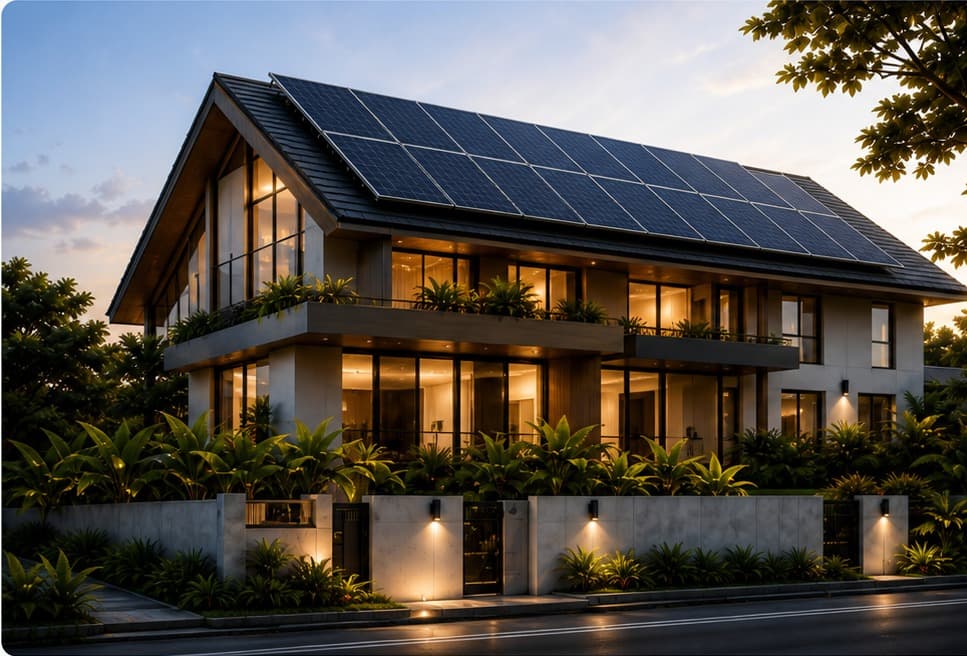
Can a Home Battery Run Your Singapore Aircon Overnight?
A 13.5kWh battery can run one to two Singapore aircon units overnight, depending on BTU rating and thermostat setting. The maths work, but the financial justification for battery storage in Singapore is stronger when framed around maximising self-consumption of daytime solar rather than grid independence overnight.
Why should this article concern you?
- 1
A single Tesla Powerwall 3 (13.5kWh usable) can run two 9,000 BTU inverter aircons at 25°C for approximately 8 to 10 hours, enough for an overnight cycle in Singapore
- 2
One aircon at 18,000 BTU draws 1.5 to 1.8kW on a hot Singapore night, a single Powerwall covers one bedroom aircon for the full overnight period with capacity to spare
- 3
The financial case for battery storage in Singapore is built on self-consumption of daytime solar generation, not on overnight aircon powering, that is a useful side benefit, not the primary justification

The question comes up in almost every Singapore solar and battery conversation: can I run my aircon overnight on the battery? The honest answer is yes, for one or two bedrooms, for one overnight cycle. But the follow-up question, should I optimise my battery system for this purpose, has a more nuanced answer that depends on how you value comfort versus financial return. The solar export guide covers how battery storage shifts the balance between self-consumption and ECIS grid export.
How Much Power Does Singapore Aircon Actually Use?
Singapore aircon consumption varies by system type, BTU rating, set temperature, and outdoor temperature. Here are the key figures you need:
| System Type | BTU Rating | Avg Draw (25°C set) | Per 8hr Night |
|---|---|---|---|
| Master bedroom (inverter) | 18,000 BTU | 1.2 to 1.8kW | 10 to 14 kWh |
| Bedroom (inverter) | 9,000 BTU | 0.6 to 0.9kW | 5 to 7 kWh |
| Living area (inverter) | 24,000 BTU | 1.5 to 2.2kW | 12 to 18 kWh |
| Whole-home (cassette) | 36,000+ BTU | 2.5 to 4.0kW | 20 to 32 kWh |
Inverter-type aircons are highly variable in draw because they modulate compressor speed to maintain temperature. At 25°C set temperature on a Singapore night (ambient ~28°C outdoor), a 9,000 BTU inverter bedroom unit draws around 0.65kW once it reaches temperature, significantly less than its rated maximum. A 18,000 BTU master bedroom unit draws around 1.4kW sustained overnight.

Powerwall 3 Overnight Aircon Scenario
The Tesla Powerwall 3 has 13.5kWh usable capacity. Running numbers for a typical Singapore scenario (house charged fully from solar during the day, overnight discharge for aircon):
Scenario A. One master bedroom (18,000 BTU inverter at 25°C): 1.4kW × 8 hours = 11.2 kWh. Powerwall covers the full overnight cycle with 2.3 kWh remaining for other loads (fridge, standby devices). Comfortable margin.
Scenario B. Two bedrooms (9,000 BTU each at 25°C): 0.65kW × 2 × 8 hours = 10.4 kWh. Powerwall covers both bedrooms overnight with 3.1 kWh remaining. Viable.
Scenario C. Master + one bedroom + living room aircon (most common request): 1.4 + 0.65 + 1.8kW = 3.85kW × 8 hours = 30.8 kWh. A single Powerwall falls well short. You would need three Powerwalls (40.5kWh combined) for full coverage, or accept that the living room runs on grid overnight.
The Financial Case: Self-Consumption First, Aircon Second
If you are evaluating a battery purely for overnight aircon coverage, the financial case in Singapore is weak. A Powerwall 3 costs approximately S$16,000 installed. Charging it from daytime solar to power aircon overnight saves approximately S$1,400 to S$1,800 per year in grid electricity (approximately 4,000 to 5,000 kWh at S$0.3478/kWh overnight grid import avoided). That is an 11 to 12 year payback from overnight coverage alone.
The financial case improves significantly when the battery is evaluated on the full picture: increasing the household's solar self-consumption from 25% (no battery) to 50 to 55% (with battery), which earns the full tariff rate on more kWh rather than the lower SCT export rate. This self-consumption uplift adds approximately S$1,200 to S$1,600 per year on a 10kWp system. Combined, the battery's annual benefit reaches S$2,600 to S$3,400, reducing payback to 5 to 6 years for a household with high daytime solar and high evening electricity use.
One Powerwall covers the master bedroom overnight. Two Powerwalls cover the whole family. The maths works — the question is whether you want to optimise the battery for financial return or for comfort, because the answers point to different system designs.
For the complete battery retrofit and upgrade guide, see the solar upgrade guide. The payback guide by property type models how battery storage changes the overall system economics across different home configurations. The Sunnify calculator shows your projected self-consumption with and without battery storage based on your household profile.
Further reading: designing the complete solar, battery, and EV system together · adding a battery to an existing solar system: AC vs DC coupling · EMA battery energy storage information.
What does this mean for your home?
- Build your battery case on self-consumption economics, not overnight comfort. The financial justification for a S$16,000 Powerwall is strongest when you frame it around raising your solar self-consumption from 25% to 50%, adding S$1,200 to S$1,600/yr to your solar return. Overnight aircon coverage is the benefit that makes the decision emotionally easy, not the one that makes it financially obvious.
- For whole-home overnight coverage including the living room, plan for three Powerwalls. One Powerwall covers one master bedroom or two single bedrooms reliably. If your requirement is broader, the cost rises to S$48,000 in battery hardware alone. At that scale, model the payback carefully rather than assuming it matches the single-Powerwall figure.
- Check whether your existing inverter supports AC coupling before purchasing any battery. Most Singapore string inverters do. AC coupling adds no inverter replacement cost and installs in a single day. Run the Sunnify estimate to see how battery storage changes your annual self-consumption rate and the resulting saving for your specific system.
What is the lifespan of a Tesla Powerwall in Singapore's climate?
Tesla warranties the Powerwall 3 for 10 years at 70% of original capacity. In Singapore's climate, daily cycling in a thermally managed battery unit degrades at approximately 2 to 3% per year under normal use. After 10 years the battery holds 70 to 80% of its original 13.5kWh capacity, approximately 9.5 to 10.8kWh. This reduced capacity still covers the Scenario A overnight aircon use case. Battery replacement at year 10 to 12 is realistic planning: replacement cost is expected to fall significantly as manufacturing scale increases, making the second-generation battery a better product at a lower price than the first purchase.
Can I add a battery to my existing solar system in Singapore without replacing the inverter?
Yes, through AC coupling. An AC-coupled battery (like the Tesla Powerwall) connects to your home's AC distribution board rather than to the inverter's DC input. This means your existing string inverter stays in place, and the battery charges and discharges through its own built-in inverter. AC coupling adds a small round-trip efficiency loss (approximately 10 to 15% more than DC coupling), but eliminates the cost of replacing a functioning inverter. It is the right approach if your existing inverter is less than 8 years old and performing well. DC coupling through a hybrid inverter becomes the better option when the inverter needs replacement anyway, as the hybrid inverter handles both solar and battery more efficiently.